

Why Washroom Users Deserve Better Hand Drying Solutions
Dr Salomé Giao, Lead Scientist at Dyson for Business, says many existing hand drying solutions are ineffective despite there never having been greater need for good hygiene practices.
Every year, Global Handwashing Day champions and campaigns for the critical importance of regular hand washing with soap.
The message is a simple one: hand washing can help prevent disease transmission.
At Dyson we’re huge advocates for everything Global Handwashing Day stands for.
We want to contribute to the conversation by shedding light on a step in the hand hygiene process that itself plays a very important role but one that crucially remains little known: hand drying.
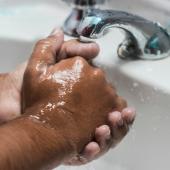
Effective hand drying is key to ensuring that clean hands stay clean – if it doesn’t happen there are hygiene risks: it is known that wet hands can pick up more bacteria than dry ones.
Moreover, damp hands can transfer up to 1,000 times more bacteria than dry hands, while wiping hands on clothes can add bacteria to washed hands if the clothes aren’t clean.
We need to ensure that people are able to wash and dry their hands properly.
Bacteria cannot be visualised by the naked eye, so instead imagine glitter.
Now imagine you have one damp hand and one dry hand, you put both hands in the glitter and what happens?
Your wet hand will be covered in glitter while the dry one will pick up less.
The process mimics the difference between wet and dry hands interacting with germs and bacteria, we just can’t see it with the naked eye.
But the big problem isn’t that hand drying options aren’t provided in washrooms.
It’s that the options on offer can in fact cause hygiene problems, alongside environmental challenges, and cost concerns.
Traditionalsolutions present big problems
Many shared washrooms will offer one of two hand drying options – or in some instances both: electric dryers and, or paper towels.
The hygiene issues that can arise from warm air dryers begin with design issues, such as physical buttons, long dry times, and other technological limitations – a lack of air filtration being a common problem.
This can impact hygiene practically and may also be a concern when using warm air dryers.
According to the 2021 Dyson survey on washroom attitudes, 40% of respondents in the UK are concerned that the physical button on warm air dryers is a hygiene issue, while the use of unfiltered, unclean air to dry hands is a concern for 24%.
This could become a deterrent to use them and leave the washroom with wet hands.
Paper towels, on the other hand, in general don’t cause hygiene concerns but they can come with environmental issues that can’t be overlooked in today’s world.
To create, transport and dispose them at scale requires processes with higherCO2 emissions.
With society becoming increasingly aware of environmental issues and the sustainability of the products they use; we need to create hand drying solutions that address them.
In a time when businesses are embedding sustainability at their core and using Corporate Social Responsibility teams to showcase progress, there’s a real opportunity to standout and make washrooms a point of differentiation.
Improvementsfor hygiene, business and environmental needs
It’s clear that the hand drying solutions often available in workplaces, educational settings, hospitality – we could go on – are in need of an upgrade.
Recent innovations in hand dryer technology place hand hygiene, the reduction of CO2 emissions, and cost efficiency at the forefront of design.
In some instances, carbon emissions of up to 88 per cent are being achieved when compared to emissions from using paper towels.
Energy efficiency is also being designed into solutions by more progressive manufacturers - by way of example, our Dyson Airblade™ 9kJ product has been demonstrated to use one-seventh the energy of conventional warm air dryers.
Key washroom safety concerns can also be addressed by manufacturers, including prioritising hygiene by offering touch-free designs with HEPA (high efficiency particulate air) filters to capture 99.95% of airborne particles as small as 0.1 microns.
Effective hand drying is a key part of effective hand hygiene, but the options too often in use are problematic.
The hand dryer industry globally need to raise awareness about the importance of effective hand drying, and promote hand drying solutions that improve hygiene, reduce business costs and CO2 emissions.